

Understanding Binding in TR-31 Protocols
The payments industry is undergoing a critical transition. Financial institutions are moving away from outdated key management methods and adopting TR–31–compliant protocols to meet PCI PIN requirements and strengthen cryptographic security. While much of the conversation around TR-31 focuses on compliance deadlines and migration strategies, one critical concept often flies under the radar: binding.
At Trusted Security Solutions, we’ve seen firsthand how a lack of understanding about binding can slow projects, create security gaps and put compliance at risk. So, let’s break it down.
What Is Binding?
In simple terms, binding is the process of securely linking two components in your ATM environment—most often the Encrypting PIN Pad (EPP) and your key management system (such as the TSS A98).
When binding is performed correctly, it ensures that cryptographic keys exchanged between these systems are unique to that pairing and cannot be intercepted or reused elsewhere. Without binding, attackers could potentially manipulate or substitute devices, undermining the integrity of your entire ATM network.
Why Binding Matters in TR-31 Migrations
We’ve noticed a recurring trend: many institutions don’t realize they need to account for binding until they’re already mid-project. By then, delays and complications often arise. As institutions migrate to TR-31 protocols, binding becomes a foundational step in securing the key exchange process, and unfortunately, it’s also one of the most misunderstood.
Here’s why binding is essential:
- It prevents security gaps. Binding ensures that the EPP and the A98 are cryptographically linked, protecting against unauthorized key injection or substitution
- It reduces migration risk. Skipping or mishandling binding can derail your transition to TR-31 compliance
- It’s a compliance requirement. Regulators expect institutions to properly bind devices and document the process
Common Challenges With Binding
Institutions that overlook binding often encounter:
- Unexpected downtime. Maintenance becomes complicated if devices aren’t properly unbound before servicing
- Data mismatches. Binding data must match between the EPP and the A98—if it doesn’t, operations grind to a halt
- Vendor confusion. Different ATM manufacturers handle binding differently, making interoperability a challenge without expert guidance
How TSS Helps Simplify Binding
Binding doesn’t have to be a barrier. At TSS, our team of experts works with all major ATM manufacturers to ensure the A98 remains interoperable and ahead of evolving standards. We guide institutions through the binding process step by step—ensuring it’s done correctly the first time and minimizing disruption to operations.
Whether you’re planning a TR-31 migration or already running into binding challenges, our team is here to help streamline the process and safeguard your institution’s compliance.
Have questions about binding and TR-31 migration? Contact our team today.

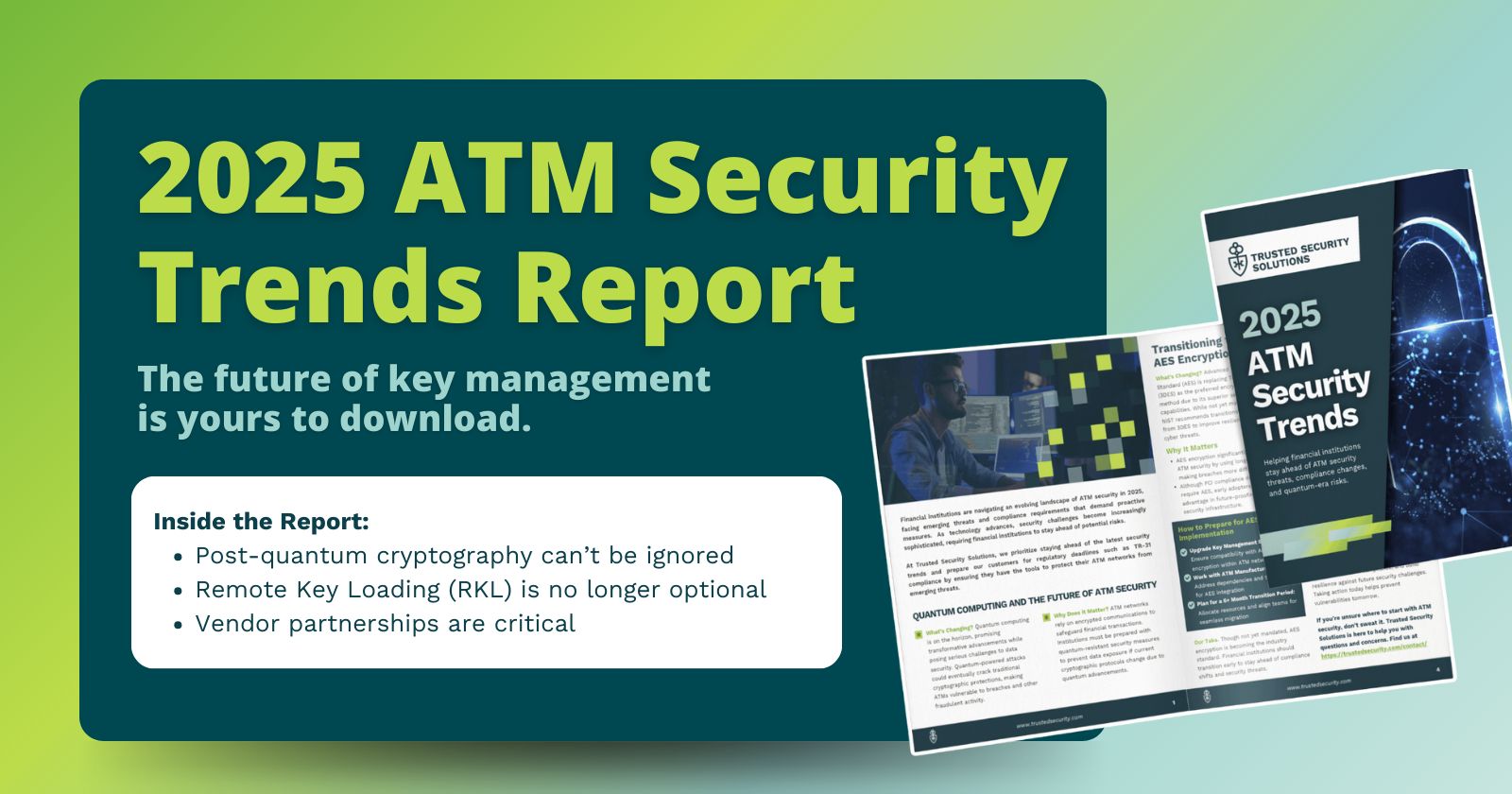
What the 2025 ATM Security Trends Report Reveals About the Future of Key Management
The ATM ecosystem is experiencing one of its most significant shifts in decades. Between regulatory deadlines, new encryption standards and the rise of more sophisticated cyberattacks, financial institutions face a complex security environment that demands both awareness and action.
To help industry leaders prepare, we’ve released the 2025 ATM Security Trends Report—a comprehensive look at what’s happening now, what’s on the horizon and how banks, credit unions and processors can take proactive steps to secure their ATM networks.
The Current Landscape: Why ATM Security Is at a Crossroads
For years, the ATM industry has relied on traditional cryptographic methods and manual processes to manage keys. While these systems have been foundational, they’re increasingly vulnerable to evolving attack vectors and out of step with modern compliance mandates.
Here’s what’s changing:
- Regulatory bodies are enforcing change. PCI PIN mandates require migration to TR-31 and TR-34 standards, which modernize how institutions exchange and protect cryptographic keys
- Threat actors are growing more sophisticated. Logical attacks and PQC (post-quantum cryptography) risks expose weak points in legacy systems
- Institutions need operational efficiency. Manual key loading is no longer scalable, and inefficiencies add unnecessary risk and cost
The 2025 report highlights how these trends converge, creating risk and opportunity for organizations willing to act now.
Key Insights From the 2025 Report
While the full report goes deep into security protocols and technology shifts, here are a few critical themes worth noting:
- TR-31 and TR-34 compliance will shape the next decade. These standards move the industry away from insecure, manual processes and toward automated, asymmetric key exchanges. Early adopters will avoid the last-minute scramble that has plagued previous compliance transitions.
- Post-quantum cryptography can’t be ignored. Quantum computing is no longer theoretical—it’s advancing rapidly. Institutions must begin exploring PQC strategies now, or risk finding themselves unprepared for a cryptographic landscape that could shift overnight.
- Remote Key Loading (RKL) is no longer optional. RKL solutions enable institutions to securely and efficiently load keys across large ATM fleets without manual intervention. The efficiency gains alone are substantial, but the security and compliance benefits make it essential.
- Vendor partnerships are critical. The ecosystem is complex. Banks and credit unions must ensure their solutions are interoperable across different ATM manufacturers, processors and vendors. Trusted partners can help avoid costly missteps.
Why Institutions Should Act Now
ATM security is not a “wait until next year” challenge. Delaying migration or ignoring looming threats can lead to rushed projects, budget overruns and compliance violations. Proactive institutions are already investing in scalable key management strategies, assessing their networks for vulnerabilities and creating roadmaps for TR-31, TR-34 and PQC readiness.
The 2025 ATM Security Trends Report offers a roadmap for navigating this complexity. It doesn’t just highlight risks, it provides practical steps for institutions to strengthen their security posture while optimizing operational efficiency.
Download the full 2025 ATM Security Trends Report to get the insights you need to stay ahead of compliance requirements and protect your institution’s reputation.
From MKL to RKL: When and Why to Make the Switch in ATM Security
The way you manage cryptographic keys is no longer just an IT detail—it’s a core business decision. ATM fleets, processors and financial institutions are under pressure to deliver secure, seamless customer experiences while protecting against increasingly sophisticated threats. In this environment, your approach to key management can make the difference between resilience and risk.
For decades, Manual Key Loading (MKL) has been the default. Teams meet at ATMs in pairs, enter keys manually and follow cumbersome procedures to remain compliant. But as technology evolves and threats multiply, relying solely on MKL is like running your business on dial-up in a fiber-optic world.
That’s why institutions are asking: When should I upgrade from MKL to RKL? The answer is simple: now.
The Security Imperative
MKL exposes institutions to one unavoidable truth: every manual touchpoint increases risk. Each key ceremony involves people, paper and physical presence—all of which are vulnerable to human error.
By contrast, Remote Key Loading (RKL) automates the process. Keys are securely transmitted and injected using asymmetric cryptography, drastically reducing exposure to clear-text keys or mishandling.
For CISOs, compliance officers and security leaders, the benefits are clear:
- Stronger protection against fraud and insider risk
- Built-in compliance with PCI PIN standards such as TR-31 and TR-34
- Future-proofing as regulators push toward eliminating outdated methods
When auditors arrive, RKL speaks for itself: a hardened, automated process that leaves less room for error and more confidence in your compliance posture.
The Operational Advantage
Ask any COO or operations leader about MKL and you’ll hear the same pain points: scheduling two-person teams, driving to locations and taking ATMs offline for key ceremonies. Each visit costs time, labor and—most critically—downtime for your customers.
RKL changes the equation. With keys delivered electronically, institutions can:
- Reduce truck rolls and in-person key ceremonies
- Minimize ATM downtime and disruption for cardholders
- Free up staff to focus on higher-value work instead of routine key management
For operations leaders, this isn’t just an upgrade in security. It’s an upgrade in efficiency.
The Business Case for Leadership
From the CEO’s perspective, every technology decision is based on ROI, reputation and resilience. RKL delivers on all three.
- Cost Savings: Less downtime and fewer truck rolls mean lower operating costs over time
- Customer Trust: A single compromise can tarnish your institution’s reputation. RKL shows proactive investment in security
- Scalability: As your ATM fleet grows or consolidates, RKL ensures your cryptographic infrastructure can keep pace
In short, RKL is a strategic investment in protecting your business and brand.
Why the Time Is Now
Every day that passes with MKL as your standard is another day of unnecessary risk, inefficiency and added cost. The move to RKL is no longer a matter of if—it’s a matter of when.
For financial institutions, processors and OEMs, the smartest move is to transition before regulatory mandates or security incidents force your hand. Early adopters aren’t just compliant—they’re confident, efficient and better prepared for the future.
Ready to Upgrade?
At Trusted Security Solutions, we’ve helped institutions of every size move seamlessly from MKL to RKL. Our A98 ATM Key Management System is designed to meet you where you are today and scale with you tomorrow.
Why wait for a crisis? Make the move now. Contact us to see how RKL can transform your security, operations and bottom line.

How to Prepare for TR-34: Key Steps for ATM Compliance and Remote Key Loading
As the ATM and payments ecosystem rapidly evolves, so do the standards that govern it. One of the most pressing changes facing financial institutions, processors and Original Equipment Manufacturers (OEMs) is the shift toward PCI PIN’s TR-34 standard for key management. While full enforcement may still feel distant, the time to act is now.
What Is TR-34 and Why Does It Matter?
TR-34 is a standard defined by the PCI Security Standards Council that outlines a secure method for distributing symmetric keys using asymmetric (public key) cryptography. In short, it introduces a safer, automated and more scalable way to handle cryptographic keys between hosts and devices.
It is part of a broader industry move toward stronger encryption practices and the retirement of insecure, legacy key-loading methods, especially those involving clear-text keys or manual key entry.
Why Prepare Now?
Although TR-34 compliance is not yet mandatory across all regions or devices, regulators and card brands are strongly encouraging early adoption. As we’ve seen with other PCI initiatives, waiting until the last minute can lead to rushed implementations, operational disruptions and compliance risks.
Being proactive about TR-34 offers several benefits:
- Improved security through the elimination of manual processes
- Reduced key management overhead
- Future-proofing infrastructure
- Compliance readiness ahead of deadlines
Steps to Take Today
Conduct a Key Management Audit
Start by assessing your current key-loading practices. Are you still using manual key loading (MKL)? Are your key exchanges still dependent on paper-based processes or insecure methods?
Look for gaps in:
- Physical security controls
- Key injection workflows
- Documentation and tracking
Understand Your Equipment's Compatibility
Not all ATMs or Hardware Security Modules (HSMs) are TR-34 ready. Work with your vendors, or contact TSS, to determine:
- Which devices support TR-34 today
- What firmware or hardware upgrades may be required
- If a remote key-loading platform like A98-RKL is supported
Start Planning Your Migration Strategy
TR-34 implementation isn't plug-and-play. It requires:
- Generating key pairs
- Setting up secure key exchange infrastructure
- Updating procedures and training your team
Invest in Remote Key Loading
If you haven’t already adopted Remote Key Loading (RKL), now is the time. Not only does RKL significantly streamline key management, but platforms like the TSS A98-RKL are also TR-34 ready, providing you with a future-proof solution that scales with compliance needs.
Want to learn more about the A98 RKL? Read our guide on Future-Proofing Your ATMs.
Engage with Your Vendors and Partners
Ensure your ATMs, HSM, and core banking software are also on the path to TR-34. Collaboration is key—literally.
Ask:
- Is your equipment ready for TR-34?
- How are your vendors preparing for the change?
- What’s the timeline for upgrades?
Don't Wait to Get Ahead of TR-34
The path to TR-34 doesn’t have to be complicated, but it does require planning. At Trusted Security Solutions, we’ve helped financial institutions navigate every key management standard and we’re here to help you stay ahead.
Learn how to implement TR-34 the right way—before compliance deadlines catch up.
📞 Contact us to start your TR-34 readiness plan

Steps for Consolidating ATM Equipment for Credit Union Success
As credit unions work to deliver convenient, secure and modern member services, ATM fleet management often becomes a silent drain on time and resources. Many still rely on outdated hardware, manual key loading and multiple vendor contracts, resulting in high costs and compliance vulnerabilities.
But it doesn’t have to be this way. ATM equipment consolidation—especially when paired with cloud-based infrastructure and remote key loading—can reduce operational strain and future-proof your credit union’s ATM strategy. Here’s how to get started.
Step 1. Start with a Full Infrastructure Assessment
Before making changes, credit unions need a clear view of their current ATM environment. That includes:
- The total number of terminals across branches
- Vendor contracts for hardware, software and service
- Encryption methods and compliance status
- Frequency of manual interventions or site visits
Outdated equipment or unsupported software may be driving up maintenance costs or creating security risks, especially if it no longer aligns with PCI DSS, TR-31/TR-34, or PCI PIN standards.
How TSS Can Help:
Trusted Security Solutions (TSS) works with credit unions to identify fleet inefficiencies, assess encryption protocols and flag non-compliance risks. Our team can help develop a roadmap for consolidation that minimizes disruption.
Step 2. Migrate ATM Management to the Cloud
One of the most effective ways to consolidate ATM operations is through cloud migration. Moving to the cloud enables centralized management, real-time fleet visibility and reduced physical service calls.
Benefits include:
- Reduced hardware and software maintenance
- Remote diagnostics and update capabilities
- Scalable growth across new or merged locations
How TSS Can Help:
From implementation to ongoing support, TSS helps credit unions securely transition to cloud-based ATM environments. We ensure each deployment aligns with PCI best practices, and we provide insight into securing data at every layer of the migration.
Explore our detailed Cloud Migration Guide →
Step 3. Eliminate Manual Key Loading with A98 RKL
Manual key loading remains one of the most time and resource-intensive parts of ATM management. It also introduces risk, both from human error and from physical key handling procedures that are no longer compliant under newer PCI PIN guidelines.
Remote Key Loading (RKL) enables secure, automated key exchanges without requiring an on-site technician.
With A98 RKL from TSS, credit unions can:
- Drastically reduce the number of truck rolls to ATMs
- Strengthen key security through encrypted key delivery
- Meet PCI PIN 3.1 and TR-34 requirements with ease
Step 4. Streamline Vendors and Service Agreements
Many credit unions work with multiple vendors for hardware, key management, maintenance and compliance support, often leading to disjointed workflows and redundant costs.
Consolidation provides an opportunity to renegotiate service terms, unify contracts and ensure that all vendors are aligned with your long-term strategy.
How TSS Helps:
TSS acts as a strategic partner across your ATM lifecycle—not just for key management, but also for compliance planning, system integration and security audits. We help you simplify operations while keeping your institution protected.
Step 5. Build for Compliance and Future Growth
ATM consolidation isn’t just about cutting costs; it’s about staying resilient as the regulatory landscape evolves. From PCI DSS v4.0 to emerging requirements in encryption and access control, staying compliant means staying proactive.
Consolidation allows your institution to:
- Replace legacy systems before they create vulnerabilities
- Adapt quickly to new ATM software and encryption standards
- Free up IT resources for innovation, not routine maintenance
Consolidation is a Strategy, Not Just a Cost-Saver
When approached thoughtfully, ATM consolidation delivers more than operational efficiencies; it creates a stronger, more agile foundation for your credit union’s future. Whether you’re migrating to the cloud, centralizing key management or simplifying vendor contracts, each step should support long-term member service and institutional growth.
Let’s simplify your ATM strategy together.
Contact TSS to start your consolidation plan.
PCI Compliance Made Simple: A Guide for Credit Unions
When members swipe their cards or pay online, they trust their credit union to keep their financial data safe. The Payment Card Industry Data Security Standard (PCI DSS) sets the framework for how financial institutions like credit unions should handle, process and store cardholder data. This guide breaks down the essentials of PCI DSS and offers practical steps to help your credit union stay secure and in compliance.
What is PCI DSS?
PCI DSS stands for Payment Card Industry Data Security Standard. It's a set of security requirements developed by major credit card companies like Visa, Mastercard, American Express, Discover and JCB, to protect cardholder data. Organizations storing, processing or transmitting card information must adhere to these standards. So for credit unions, this means ensuring every channel, whether it’s an ATM, teller transaction, online banking platform or mobile app, is secure.
Why PCI Compliance Matters for Credit Unions
PCI compliance is critical because it:
- Prevents costly data breaches: Noncompliance can lead to fines, lawsuits and lost member trust.
- Ensures operational continuity: Secure systems minimize downtime caused by attacks or fraud investigations.
- Demonstrates member commitment: Meeting industry standards reinforces your role as a trusted financial partner.
Practical Tips for Credit Unions
Becoming PCI compliant may feel daunting, but here’s how your credit union can get started:
- Start with a self-assessment questionnaire (SAQ): The PCI Security Standards Council provides SAQs tailored to your size and card transaction methods.
- Know your environment: Map out all systems and channels that handle cardholder data, including ATMs, POS systems, mobile apps and third-party vendors.
- Segment your network: Isolate cardholder data from the rest of your network to reduce risk and scope.
- Partner with compliant vendors: From ATM networks to cloud service providers, ensure your partners meet PCI standards.
- Train your team: Security isn’t just IT’s responsibility. All employees should understand their role in protecting cardholder data.
- Schedule regular audits: Compliance is not a one-time event. Make assessments part of your annual operational review.
Common Mistakes to Avoid
- Avoid relying solely on third-party compliance: Vendors must be compliant, but your credit union is still responsible for overall cardholder data security.
- Avoid ignoring endpoint security: All devices, including ATMs and teller terminals, must be monitored and protected.
- Failing to update policies: If your credit union hasn’t updated its security policy in over a year, it’s time to revisit it.
Compliance Culture
PCI compliance is about creating a culture of security. By simplifying the process, engaging your team and investing in the right tools and partnerships, your credit union can meet its obligations and continue serving members with confidence and integrity.
Need Help Getting Compliant?
Our team can help you assess your current environment, guide you through your SAQ, and help support your PCI DSS efforts.

Partnerships in ATM Security: Why Expertise Matters
In the evolving world of ATM security, having the right partner can make a significant difference. As technology advances and regulatory requirements grow more complex, financial institutions and ATM operators benefit from working with experts who understand the nuances of compliance, encryption and risk management.
With decades of experience and deep specialization in ATM security, Trusted Security Solutions (TSS) empowers financial institutions to stay ahead of risks and regulatory changes. In this article, we’ll explore three critical service areas where partnerships make all the difference and why having TSS in your corner is a strategic advantage.
PCI Compliance: Partnering for Proactive Protection
The Payment Card Industry Data Security Standard (PCI DSS) constantly evolves. Staying compliant means understanding technical updates, anticipating changes and adapting quickly—all while maintaining operational efficiency.
Why Partner with TSS?
- TSS monitors the latest developments from the PCI Security Standards Council and translates them into actionable strategies for your ATM environment.
- We support clients through upcoming mandates and certifications, helping mitigate costly non-compliance risks.
- Whether navigating compliance frameworks like PCI PIN or managing multi-vendor ATM environments, TSS works closely with clients to deliver tailored guidance and operational support.
TR-31/TR-34 Key Management: Securing the Foundation
Proper key management is essential for secure ATM transactions. TR-31 and TR-34 standards define how cryptographic keys should be shared, transported and stored, and getting them wrong can lead to vulnerabilities.
Why partner with TSS?
- TSS is a leader in ATM key management services. We help institutions transition smoothly to TR-31 and TR-34, ensuring compliance and resilience.
- Our team establishes secure key handling from injection to distribution across complex environments.
- By offering key management tools and custom implementation plans, we help reduce manual errors and strengthen your cryptographic framework.
PQC and AES Encryption: Future-Proofing Security Today
As technology progresses, so do encryption practices. Many ATM operators are familiar with AES (Advanced Encryption Standard) as a current best practice for securing sensitive data. At the same time, conversations around post-quantum cryptography (PQC) are becoming increasingly relevant as the industry begins to explore how emerging computing capabilities may affect long-term data protection.
Why Partner with TSS?
- TSS works with clients to implement and maintain AES encryption practices that align with current standards.
- Our team assists with future preparedness by offering education and strategy around crypto-agility and PQC readiness.
- By staying informed on evolving encryption guidance from regulatory bodies and industry leaders, we build systems and roadmaps that allow for seamless adoption of new encryption methods as they become available.
The Power of Partnership
ATM security isn’t a set-it-and-forget-it scenario. It requires constant vigilance, specialized knowledge and the agility to adapt to change. With TSS as your partner, you don’t just keep up, you stay ahead.
Whether you're navigating PCI compliance, implementing secure key management, or preparing for post-quantum threats, our team brings the expertise and foresight needed to protect what matters most.
Let’s build your ATM security strategy together.

ATM Security Standards 101: Key Organizations You Should Know
ATM security doesn’t happen in a vacuum. Behind the scenes, global organizations constantly update frameworks, encryption protocols and best practices to keep financial systems secure. These resources form the backbone of the policies, procedures and technologies institutions depend on to protect cardholder data, maintain regulatory compliance and stay ahead of emerging threats.
Trusted Security Solutions (TSS) is an active member of three leading organizations shaping the future of ATM security: PCI, X9 and ATMIA. Understanding these organizations and their roles is key to building a resilient, compliant ATM network.
Here’s a closer look at four essential security resources and why they matter for your institution's long-term success:
The Payment Card Industry Security Standards Council (PCI SSC)
The Payment Card Industry Security Standards Council (PCI SSC) plays a critical role in safeguarding cardholder data worldwide. Formed by major payment brands like Visa and MasterCard, PCI SSC is responsible for security standards such as PCI DSS (Data Security Standard) and PCI PIN.
- These requirements govern how card data is transmitted, processed and stored within ATM networks.
- Compliance with PCI standards is mandatory for any institution handling debit and credit card transactions.
Financial institutions that process these transactions depend on PCI SSC standards to protect cardholder data and meet regulatory requirements. As a participating member of PCI SSC, we remain actively engaged with evolving requirements to ensure our clients remain compliant, audit-ready and better protected against fraud.
Accredited Standards Committee (X9)
The Accredited Standards Committee X9, commonly known as X9, develops standards for the U.S. financial services industry with a strong focus on data security, cryptographic protocols and secure key management.
- Standards like TR-31 and TR-34, essential to Remote Key Loading (RKL) operations, originated from X9 initiatives.
- These technical standards ensure secure, efficient management of cryptographic keys across ATM networks.
Institutions looking to implement Remote Key Loading, prepare for PCI PIN 3.1, or stay ahead of PCI 4.0 requirements rely heavily on the frameworks established by X9. As a proud member, TSS helps clients navigate these standards to maintain the highest levels of security and compliance.
ATM Industry Association (ATMIA)
The ATM Industry Association (ATMIA) is a global non-profit dedicated to advancing the ATM industry.
- ATMIA brings together banks, credit unions, manufacturers, service providers and security experts to address shared challenges like cybercrime, physical attacks and technology modernization.
- Their industry blueprints, best practice guides and advocacy efforts help shape the future of ATM operations worldwide.
As the ATM industry continues to evolve in response to new technologies and customer expectations, having insight is essential. Membership with ATMIA keeps us informed of emerging trends and solutions, allowing us to support our clients as the industry evolves from operating system migrations to cloud-based ATM management.
The National Institute of Standards and Technology (NIST)
The National Institute of Standards and Technology (NIST) is a U.S. government agency that develops cybersecurity standards and best practices.
- NIST’s Cybersecurity Framework is widely recognized across industries as the foundation for managing cyber risks, including those in the financial sector.
- Their guidelines support secure cryptographic operations, risk assessments and data protection—key pillars of any secure ATM network.
Following NIST frameworks supports regulatory compliance and strengthens your institution’s resilience against evolving threats, making it a cornerstone resource for those managing ATM infrastructure.
Staying Ahead of the Curve
Staying connected to organizations like NIST, PCI SSC, X9 and ATMIA is key to building a stronger, more secure ATM operation. These organizations play a central role in shaping the standards that guide how the industry protects data, manages risk and prepares for the future.
At TSS, our active involvement ensures our clients stay ahead of regulatory changes, security threats and the evolving landscape of ATM technology.
If you’re looking to strengthen your ATM security strategy, contact the TSS team to learn how our solutions align with the industry’s most trusted standards—and how we can help protect and future-proof your ATM network.

Cloud Migration in the ATM Industry: Key Security Considerations
As the ATM industry increasingly adopts cloud computing to enhance operational efficiency and customer service, it must navigate the complex security landscape associated with this transition. Cloud migration offers significant benefits, including scalability, cost savings and enhanced security measures. However, it also introduces unique challenges, particularly around data security, regulatory compliance and service availability. ATM operators can achieve a secure and efficient cloud migration by understanding these challenges and leveraging cloud technology's benefits.
Challenges of Cloud Migration in the ATM Industry
Challenge #1: Data Security and Privacy
ATMs handle sensitive financial data, making data security a critical concern during cloud migration. The complexity of migrating sensitive data to the cloud involves safeguarding it from unauthorized access, data breaches, and potential cyberattacks.
What to Consider:
- Encryption: Ensure data is encrypted both in transit and at rest to protect against unauthorized access.
- Access Controls: Implement strict access controls to ensure that only authorized personnel can access sensitive information.
- Regular Audits: Conduct regular security audits to identify and rectify potential vulnerabilities.
Read more on Data Security and Cloud Migration
Challenge #2: Service Availability and Reliability
ATMs are expected to provide continuous service, and reliance on cloud services introduces potential risks, including service outages beyond an organization's control. Ensuring consistent service availability requires robust service level agreements (SLAs) and contingency planning.
What to Consider:
- Redundancy and Scalability: Leverage cloud infrastructure for redundancy and scalability to maintain continuous service availability.
- Service Level Agreements (SLAs): Establish robust SLAs with cloud service providers to ensure agreed-upon uptime and response times.
- Contingency Plans: Implement contingency plans and disaster recovery strategies to minimize service disruptions.
Read more on ATM Planning, Preparation and Deployment
Challenge #3: Compliance and Regulatory Requirements
The ATM industry is subject to stringent regulations, including the Payment Card Industry Data Security Standard (PCI DSS). Migrating to the cloud requires organizations to ensure that cloud service providers (CSPs) comply with these regulatory standards, necessitating continuous monitoring and regular audits.
What to Consider:
- Requirements: Familiarize oneself with the latest ATM compliance standards, including PCI mandates, to meet all legal and security requirements.
- Compliance Dates: Keep track of important deadlines for PCI compliance to avoid penalties and ensure ATMs remain secure.
- Collaboration with Providers: Work closely with cloud service providers to ensure their services align with regulatory requirements.
Learn more about PCI DSS Compliance
How TSS Can Help
Navigating complex regulatory landscapes can be challenging, but TSS has the expertise and resources to guide ATM operators through every step of the compliance journey. With an in-depth understanding of PCI DSS requirements and other industry standards, TSS helps organizations:
- Interpret and Implement Regulatory Requirements: TSS stays current with the latest compliance mandates, ensuring that your ATM operations are always aligned with current legal and security requirements.
- Track and Manage Compliance Dates: TSS’s compliance management solutions include proactive tracking of important deadlines, ensuring you never miss critical compliance updates.
- Seamless Collaboration with Cloud Providers: TSS works closely with your chosen cloud service providers to guarantee that their services comply with PCI DSS and other regulatory standards. This ensures a secure and compliant cloud migration, reducing risk and enhancing operational efficiency.
By partnering with TSS, financial institutions can confidently navigate the complexities of cloud migration while adhering to industry regulations.
For more information, see Future-Proofing Your ATMs: Why Upgrading Outdated Technology is a Security Imperative.
Contact TSS today to learn how we can support your cloud compliance needs.
Benefits of Cloud Migration in the ATM Industry
Benefit #1: Enhanced Cybersecurity Measures
Cloud service providers have made significant investments in cybersecurity, including advanced threat detection, regular security updates, and robust encryption protocols. Migrating ATM operations to the cloud can leverage these enhanced security measures, providing a fortified defense against cyber threats.
What to Consider:
- Advanced Threat Detection: Utilize cloud-based threat detection systems for real-time monitoring of security incidents.
- Regular Security Updates: Ensure cloud service providers implement regular security updates to protect against evolving cyber threats.
- Multi-Layered Security: Deploy multi-layered security measures for comprehensive protection, including firewalls and intrusion detection systems.
Discover Enhanced Security with Cloud Migration
Benefit #2: Increased Service Availability and Redundancy
Cloud migration enhances service availability through scalable resources and built-in redundancy. By leveraging cloud infrastructure, ATM operators can ensure continuous service, even during maintenance or unexpected disruptions.
What to Consider:
- Continuous Service: Ensure uninterrupted ATM services to enhance customer experience and trust.
- Scalable Resources: Utilize cloud platforms to dynamically scale resources during peak demand, preventing system overloads and downtime.
- Operational Resilience: Implement built-in redundancy and failover systems to minimize the impact of hardware failures or network issues.
Read more on ATM Planning, Preparation and Deployment
Benefit #3: Enhanced Incident Response and Recovery
Cloud integration can significantly improve incident response capabilities by enabling real-time threat detection, centralized logging, and rapid deployment of security patches. A well-orchestrated incident response plan allows for quick containment of security incidents, minimizing downtime and protecting sensitive customer data.
What to Consider:
- Rapid Response: Quickly identify and mitigate security incidents to minimize impact.
- Centralized Logging and Analysis: Implement centralized logging systems to monitor and analyze security events across cloud environments.
- Post-Incident Analysis: Conduct thorough post-incident analyses to understand the breach and implement measures to prevent future occurrences.
Benefit #4: Cost Efficiency and Scalability
Migrating to the cloud allows ATM operators to scale resources based on demand, reducing costs associated with maintaining physical infrastructure. This flexibility enables better budget management and operational efficiency.
What to Consider:
- Scalable Resources: Leverage cloud infrastructure’s scalability to adjust resources based on demand fluctuations, reducing costs.
- Operational Efficiency: Utilize cloud-based tools and automation to enhance operational efficiency and reduce manual interventions.
- Cost Management: Monitor and optimize cloud usage to ensure cost-effective operations and prevent overspending.
Source: ATM Industry Association (ATMIA)
Balancing Security Challenges and Cloud Benefits
Cloud migration presents the ATM industry with a strategic opportunity to enhance operational efficiency, scalability, and security. However, it also introduces complex challenges that require meticulous planning and proactive security measures. ATM operators can achieve a secure and successful cloud migration by understanding the potential risks and leveraging the significant benefits of cloud technology.
With extensive experience in cloud security, regulatory compliance, and operational efficiency, Trusted Security Solutions offers end-to-end solutions to protect sensitive data, ensure continuous service availability, and maintain compliance with industry standards like PCI DSS. Our team of experts collaborates closely with your organization and cloud service providers to deliver seamless cloud migration strategies that enhance security and efficiency while minimizing risks.
Contact TSS today to learn how our industry-leading solutions can empower your organization to securely and efficiently navigate the complexities of cloud migration in the ATM industry.
To stay updated on the latest industry trends and security best practices, visit trustedsecuritysolutions.com.

Risks of Non-Compliance: Why PCI Standards Matter for ATM Security
In today's rapidly evolving financial landscape, Automated Teller Machines (ATMs) remain a critical touchpoint for consumers. Ensuring their security is paramount, and adherence to the Payment Card Industry Data Security Standard (PCI DSS) plays a pivotal role in this endeavor.
Trusted Security Solutions (TSS) leads the industry in ATM Key Management and PCI PIN Compliance, offering a comprehensive suite of solutions that ensure ATMs remain compliant with the latest PCI DSS standards. With over 25 years of expertise, TSS provides advanced security systems designed to protect sensitive cardholder data and prevent fraud.
Why PCI DSS Matters
ATMs handle sensitive cardholder data, making them prime targets for cyber-attacks. Compliance with PCI DSS protects customer data and safeguards the reputation and financial stability of institutions operating ATMs.
How TSS Can Help:
We offer robust Key Management Systems that secure data during storage and transmission, preventing unauthorized access and protecting against cyber-attacks. Our solutions are specifically designed to safeguard sensitive cardholder data, ensuring compliance while maintaining operational integrity.
Understanding PCI DSS
PCI DSS is a comprehensive set of requirements designed to ensure that all entities involved in processing, storing, or transmitting credit card information maintain a secure environment. For ATM operators, this means implementing measures that protect cardholder data and prevent fraud.
How TSS Can Help:
We provide a holistic approach to PCI DSS compliance through solutions like the A98 Key Management System, which enables ATM operators to implement the necessary security measures effortlessly. Their expertise ensures that all aspects of PCI DSS requirements are met, from data encryption to secure network architecture.
Consequences of Non-Compliance
Failing to comply with PCI DSS can lead to severe repercussions, including:
- Financial Penalties: Non-compliance can result in substantial fines, which can escalate with repeated violations.
- Reputational Damage: Security breaches due to non-compliance can erode customer trust and tarnish an organization's reputation.
- Operational Disruptions: Breaches can lead to system downtimes, affecting service availability and leading to potential revenue loss.
PCI Standards in ATM Security
As the ATM industry evolves with the adoption of cloud technologies, PCI Security Standards remain a cornerstone of safeguarding sensitive financial data. These standards provide a robust framework for protecting against data breaches, ensuring regulatory compliance and maintaining customer trust. By implementing PCI-compliant security measures and staying informed about evolving requirements, financial institutions can effectively manage risks and maintain the integrity of their ATM networks.
Key PCI DSS Requirements for ATMs
To achieve compliance, ATM operators should focus on several critical areas:
- Secure Network Architecture: Implement firewalls and network segmentation to protect cardholder data.
- Encryption of Data: Ensure that cardholder information is encrypted during transmission and storage.
- Access Control Measures: Restrict access to cardholder data to authorized personnel only.
- Regular Monitoring and Testing: Continuously monitor networks and conduct regular security assessments to identify and address vulnerabilities.
Upcoming Compliance Deadlines: TR-31 Key Block Requirements
With the January 1, 2025, deadline for TR-31 Key Block Compliance now in effect, financial institutions must ensure ongoing adherence to the latest PCI Security Standards. This compliance update mandates enhanced security for ATM PIN pads by requiring the use of TR-31 key blocks to safeguard encryption keys during storage and transmission.
How TSS Can Help:
As an industry leader in ATM Key Management and PCI PIN Compliance, Trusted Security Solutions (TSS) provides comprehensive solutions to ensure TR-31 compliance. Our expertise in deploying secure key management systems empowers financial institutions to transition seamlessly to TR-31 while maintaining the highest security standards.
Secure Your ATM Network Today
In a world where cyber threats are constantly evolving, PCI standards are not just a regulatory obligation – they are a strategic necessity for securing the future of ATM operations. To ensure your ATM network remains compliant and secure against emerging threats, partner with Trusted Security Solutions, an industry leader providing cutting-edge ATM Key Management and PCI PIN Compliance solutions designed to meet evolving security standards, including the latest TR-31 requirements.

TR-31 vs. TR-34: What’s the Difference?
In the world of ATM security and key management, compliance with industry standards is essential to ensure secure operations and maintain customer trust. Two commonly discussed standards are TR-31 and TR-34, each addressing distinct aspects of encryption key management and distribution. While both are vital to financial institutions, understanding their differences can help you determine how they apply to your operations.
This article provides an overview of TR-31 and TR-34, their primary functions, differences and how they benefit financial institutions in enhancing encryption key management and compliance.
What Is TR-31?
TR-31, short for Technical Report 31, governs the secure storage and transmission of symmetric cryptographic keys during their operational life cycle. It provides a framework for managing symmetric cryptographic keys in a standardized format, focusing on:
1. Key Block Format:
TR-31 defines how encryption keys are arranged within a key block to ensure secure storage and transfer. These key blocks contain metadata that specifies how the key is intended to be used, aiding in clear identification and management of each key.
Common metadata includes:
- Algorithm information
- Usage information
- Distribution information
2. Operational Key Management:
It ensures the secure handling of cryptographic keys as they perform functions like encrypting PINs or facilitating secure communications. Learn more about TR-31 and how the TSS A98 Key Management System simplifies ATM key management.
3. Compliance with Standards:
TR-31 enhances institutions ability to comply with regulatory requirements by protecting keys during their entire lifecycle, from generation to eventual retirement.
What Is TR-34?
TR-34, or Technical Report 34, focuses on the initial distribution and injection of asymmetric crytographic keys into secure devices like ATMs and payment terminals. This standard facilitates:
1. Remote Key Distribution:
TR-34 supports the secure generation and delivery of keys from a central key management system to an endpoint, such as an ATM’s secure cryptographic module.
2. Public Key Infrastructure (PKI):
Unlike TR-31, TR-34 utilizes PKI for key delivery, utilizing certificates to ensure that both the sender (key management system) and receiver (ATM) are authenticated and trusted.
3. Key Initialization:
TR-34 is specifically designed for key injection, ensuring that secure devices begin their operations with the necessary encryption keys already in place.
Key Differences Between TR-31 and TR-34
| Characteristic | TR-31 | TR-34 |
|---|---|---|
| Primary Focus | Secure management of operational encryption keys | Initial distribution and injection of keys |
| Technology Used | Private Shared Symmetric Key | Public Key Infrastructure (PKI) |
| Purpose | Securely stores and transmits data | Establishes secure initial key relationships |
| Encryption | Symmetric encryption | Asymmetric encryption |
How They Work Together
TR-31 and TR-34 are not competing standards but complementary ones. While TR-34 ensures that cryptographic keys are securely distributed to devices, TR-31 takes over once those keys are in use, ensuring their secure handling throughout their lifecycle. Together, they form a robust framework for end-to-end encryption key management.
Why Understanding These Standards Matters
For financial institutions and ATM management companies, compliance with TR-31 and TR-34 is more than a regulatory requirement—it’s a critical step in protecting sensitive customer data and maintaining trust. Adopting solutions that support both standards ensures that your organization is prepared for the evolving landscape of digital security.
By leveraging platforms like the TSS A98 Key Management System, you can simplify compliance with TR-31 and TR-34 while enhancing operational efficiency. Whether you’re managing keys in use or initializing them in new devices, the A98 provides the tools you need to stay secure and compliant.
Understanding the differences between TR-31 and TR-34 allows financial institutions to implement more secure and efficient encryption key management strategies. While TR-34 sets the stage with secure key distribution, TR-31 ensures ongoing protection as those keys perform critical functions. Together, these standards form the foundation of a resilient security ecosystem.
If you’re ready to explore how TR-31 and TR-34 compliance can benefit your institution, contact us to learn more about the TSS A98 system and how it can support your security goals.

How ATM Key Management Systems, Like the A98, Help Reduce Fraud and Enhance Security
In today’s financial landscape, where cyber threats are evolving rapidly, securing ATM networks is more critical than ever. Financial institutions, from large banks to credit unions, must protect their ATMs from fraud while meeting stringent compliance requirements. One of the most effective tools for achieving this is a robust ATM Key Management System like the A98 from Trusted Security Solutions (TSS).
ATM key management is the cornerstone of secure ATM operations, ensuring that sensitive data remains encrypted and protected from malicious actors. In this blog, we’ll explore how the A98 Key Management System helps reduce fraud, enhance security and streamline operations. We’ll also highlight the benefits of Remote Key Loading (RKL) and the Comvelope System, for ATMs that don’t support RKL, showing why the A98 is the gold standard in ATM security.
Why ATM Key Management is Essential
ATM key management refers to the process of securely generating, distributing and installing encryption keys that protect communications between ATMs and a financial institution’s host network. Without proper key management, ATMs are vulnerable to:
- Fraudulent Attacks: Unauthorized access can lead to stolen funds or compromised customer data.
- Cyber Threats: Outdated or poorly managed keys create security gaps that hackers can exploit.
- Compliance Violations: Failing to meet security standards (such as TR-31) can result in penalties and reputational damage.
Robust key management ensures that encryption keys are securely handled and updated, maintaining the integrity of ATM networks and protecting against fraud.
The Challenges of Traditional Manual Key Loading (MKL)
Manual Key Loading (MKL) has long been the standard for ATM key management. In an MKL process, encryption keys are split into multiple components and entered manually by two or more authorized technicians. While this method is the minimum requirement for ATM compliance, it comes with significant complexities and challenges:
- Human Error: A single mistake during key entry can invalidate the key, causing downtime and security vulnerabilities.
- Logistical Complexity: MKL requires the presence of multiple technicians on-site, which increases labor expenses and adds logistical challenges due to the need for secure coordination, storage and management of key components for ATM repairs or updates.
- Scalability Issues: Managing keys for a large ATM fleet is time-consuming and inefficient.
While secure, MKL is resource-intensive and prone to errors, making it less suitable for modern, large-scale ATM operations.
TSS A98 Key Management System: The Gold Standard in ATM Security
The TSS A98 Key Management System is a smarter, more secure and efficient approach to ATM key management. The A98 system supports Remote Key Loading (RKL) and the Comvelope System, providing flexibility for different ATM environments.
Remote Key Loading (RKL)
Remote Key Loading allows financial institutions to securely send encryption keys to ATMs without requiring on-site technicians. Here’s how RKL enhances security and efficiency:
- Reduced Fraud Risk: Keys are generated and encrypted centrally within the secure A98 system before being transmitted to ATMs. This process eliminates the risk of exposing raw key data.
- Minimized Human Error: Automation reduces the need for manual input, decreasing the likelihood of mistakes.
- Fast Key Updates: Institutions can quickly update keys across their entire ATM network, ensuring rapid response to security threats.
- Compliance Assurance: RKL meets stringent security standards, including TR-31, helping financial institutions stay compliant.
With RKL, financial institutions can maintain high levels of security while reducing the operational burdens associated with MKL.
The A98 Comvelope System
For ATMs that do not yet support Remote Key Loading, the A98 Comvelope System provides a secure and efficient alternative to traditional MKL. Comvelopes are encrypted key components that simplify the key-loading process. Key benefits include:
Flexibility
Unlike traditional key components, which must be used in matching pairs, any two Comvelopes can be selected from thousands in storage. This flexibility reduces logistical challenges and simplifies operations.
Enhanced Security
- Unopened Comvelopes: The encrypted Comvelopes ensure that even if lost or intercepted, the key components remain secure.
- Reinforced Protection: The A98 system enforces dual control, requiring two technicians to provide a Comvelope when keying an ATM, adding an additional layer of security.: The encrypted Comvelopes ensure that even if lost or intercepted, the key components remain secure. A98 additionally enforces dual control and requires more than one technician to provide a Comvelope when keying an ATM.
Operational Efficiency
- Streamlined Compliance: Two technicians are still required to maintain compliance with dual control and split knowledge. However, each technician can carry multiple Comvelopes, enabling them to service several ATMs efficiently without the need to coordinate specific key pairs.
- Operational Speed: The ability to service multiple ATMs in one trip reduces downtime and improves network efficiency.
Resilience to Errors
If a Comvelope is damaged or lost, it poses no security risk. The system’s design ensures that errors do not compromise the entire key management process.
How the A98 Reduces Fraud and Enhances Security
The A98 Key Management System addresses the shortcomings of traditional MKL by:
- Eliminating Key Exposure: Whether using RKL or Comvelopes, encryption keys remain protected during generation, transport, and installation. This reduces the risk of key theft or unauthorized access.
- Automating Processes: Automation reduces reliance on manual procedures, minimizing human error and ensuring consistency.
- Centralized Control: Financial institutions can manage keys centrally, improving oversight, accountability, and response times to security threats.
- Supporting Compliance: The A98 helps institutions meet security standards like TR-31, ensuring compliance with industry regulations.
- Facilitating Future Upgrades: The A98 is designed to support future technology advancements, making it easier for institutions to transition to full RKL adoption.
Why Financial Institutions Trust the A98
At Trusted Security Solutions (TSS), we provide dependable solutions, responsive support, and personalized expertise to help financial institutions protect their ATM networks. Our A98 Key Management System is trusted by banks, credit unions and ATM management companies worldwide because it offers:
- Unparalleled Security: Advanced encryption and secure key handling reduce fraud risks
- Operational Efficiency: Streamlined processes save time and reduce costs
- Scalability: Whether managing a handful of ATMs or thousands, the A98 adapts to your needs
- Compliance Confidence: Stay ahead of regulatory requirements with a system designed for modern security standards
In an era where ATM fraud and cyber threats are on the rise, the A98 Key Management System offers financial institutions a powerful solution for reducing risks and enhancing security. By supporting both Remote Key Loading and the Comvelope System, the A98 provides flexibility, efficiency and peace of mind.
Ready to secure your ATM network and streamline your operations? Contact Trusted Security Solutions today to learn how the A98 can help you stay protected and compliant.
You can bank on the expertise of Trusted Security Solutions with products like the A98 system.